
Ibero-America
Connecting women across the Ibero-American HVACR sector
The Consejo de Mujeres de FAIAR is building a regional platform through which women in Latin America, Spain and Portugal can gain visibility, exchange experiences and help shape the future of HVACR.
The Federación de Asociaciones Iberoamericanas de Aire Acondicionado y Refrigeración—FAIAR—connects industry associations across 13 countries. Founded in 2001, it promotes technical development, institutional cooperation and the exchange of knowledge throughout a region connected by Spanish and Portuguese, yet marked by considerable geographical, economic and cultural diversity.
Within this federation, the Women’s Council is creating connections between women already contributing to refrigeration, air conditioning, ventilation and heating across Ibero-America.
The Council seeks to increase their visibility, encourage participation and leadership, and create opportunities to connect beyond national and institutional boundaries.
From recognising a gap to building a regional response
In 2024, FAIAR publicly explained the reasons behind the creation of its Women’s Council. Women remained underrepresented in industry meetings, exhibitions, governing bodies and other influential professional spaces.
The Federation recognised that this had implications beyond equality alone. When women’s experiences and perspectives are missing, the sector loses technical talent, creativity and approaches that could contribute to innovation and problem-solving.
FAIAR identified two related challenges. Strategies to attract and develop professionals had not always considered women’s circumstances or potential contributions. At the same time, a lack of diversity could limit the perspectives available when developing technologies, businesses and responses to society’s needs.
The proposed responses included more inclusive recruitment, education that encourages women to consider HVACR careers, professional environments that value different voices, and fairer access to development and leadership opportunities.
Formally established in early 2024, the Consejo de Mujeres gave these ambitions a regional platform, with a focus on making women’s contributions visible and strengthening their participation across the industry.
A Council built across borders
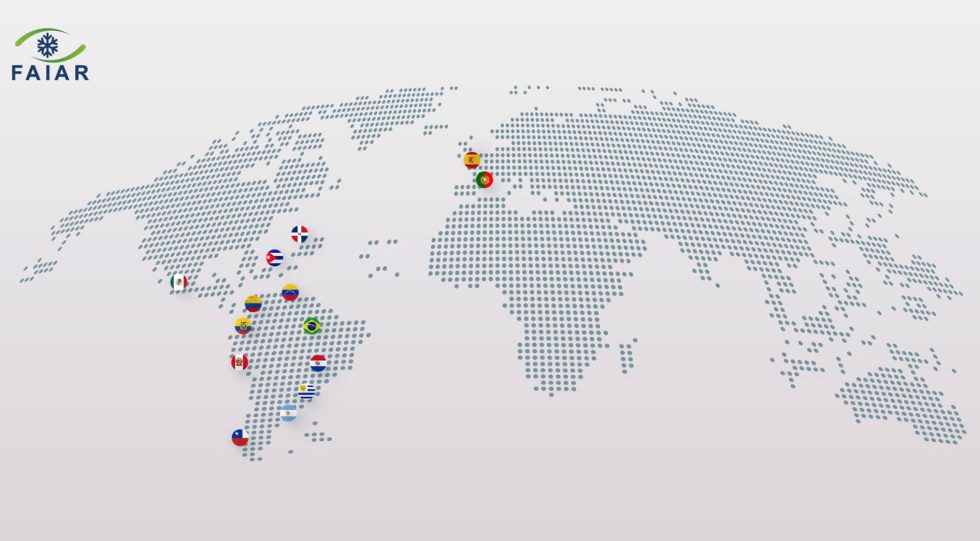
The Council’s regional character is central to its purpose. FAIAR brings together associations from Argentina, Brazil, Chile, Colombia, Cuba, Ecuador, Mexico, Paraguay, Peru, Portugal, Spain, the Dominican Republic and Venezuela.
Each country has its own industrial structure, education system and employment challenges. Women across these countries do not necessarily share the same professional experiences. Some national associations already have established women’s groups, while others are beginning to explore how to support and connect women in their sectors.
A Council within the Federation creates opportunities for these experiences to inform one another. An initiative that works in one country may inspire action elsewhere. Women can find technical and professional role models beyond their own markets, while associations exchange approaches to visibility, attracting talent and leadership.
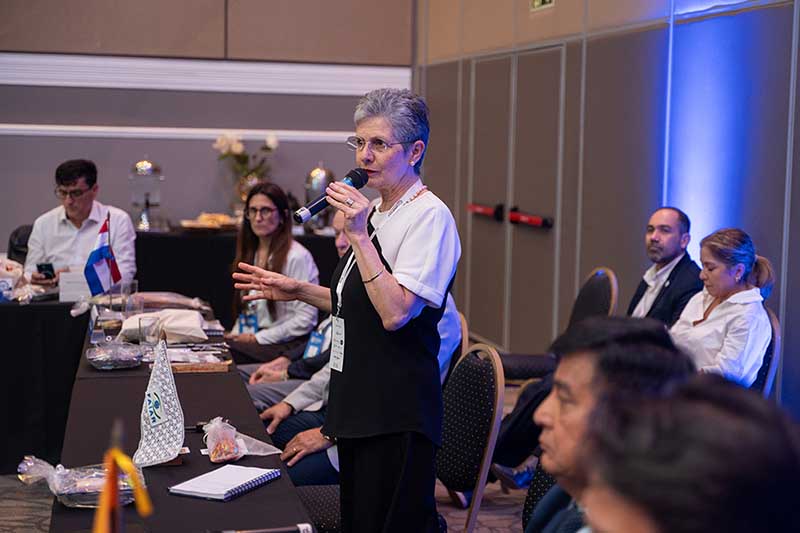
The Council’s leadership brings together representatives from several countries: President Priscila Baioco of ABRAVA in Brazil, Vice-President María Angélica Figueroa of the Chilean Chamber of Refrigeration and Air Conditioning, and Secretary Gaby Morais of CAPAREV in Paraguay.
Its wider membership includes representatives from the Dominican Republic, Mexico, Spain, Portugal and Colombia, illustrating the regional character of its work. Claudia Sánchez and Aleyani Zambrano are also among the participants identified in the supplied account of the Council’s activities.
Their involvement illustrates the value of a regional structure: experience and leadership can be shared across countries within a wider professional community.
Creating visible regional conversations
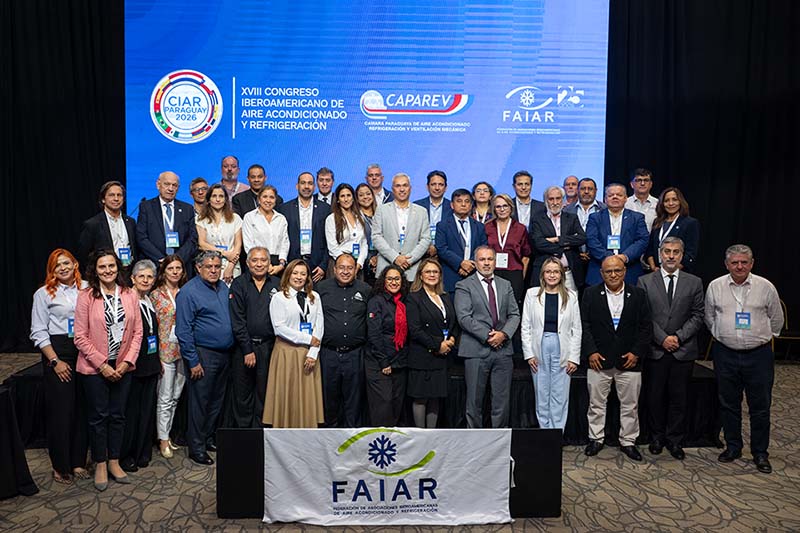
One of the Council’s early public activities was its forum during CIAR 2024 in Mexico City.
On 5 August 2025, a virtual presentation introduced the Council’s mission, objectives and leadership to women across the Ibero-American HVACR sector. The announced panel brought together Priscila Baioco from Brazil, Claudia Sánchez from Colombia and Aleyani Zambrano from Venezuela.
The online format offered an accessible way to connect without the costs and practical difficulties of international travel.
Other activities described by the Council include presenting survey findings about women in the Ibero-American refrigeration and air-conditioning industry, a virtual panel exploring experiences in HVACR, and participation in wider FAIAR meetings.
These gatherings provide opportunities to hear women’s experiences and see them moderating discussions, representing associations and speaking with technical and professional authority.
Regional conversations can also reveal that experiences which seem personal, or particular to one country, are shared elsewhere. Recognising those connections can open the way to professional relationships, shared learning and practical cooperation.
Understanding women’s experiences across the region
FAIAR’s survey provides information to help the Council understand women’s backgrounds and professional circumstances, and consider where further support may be needed.
The findings are presented in Spanish, Portuguese and English, reflecting the languages of its regional community and wider international connections.
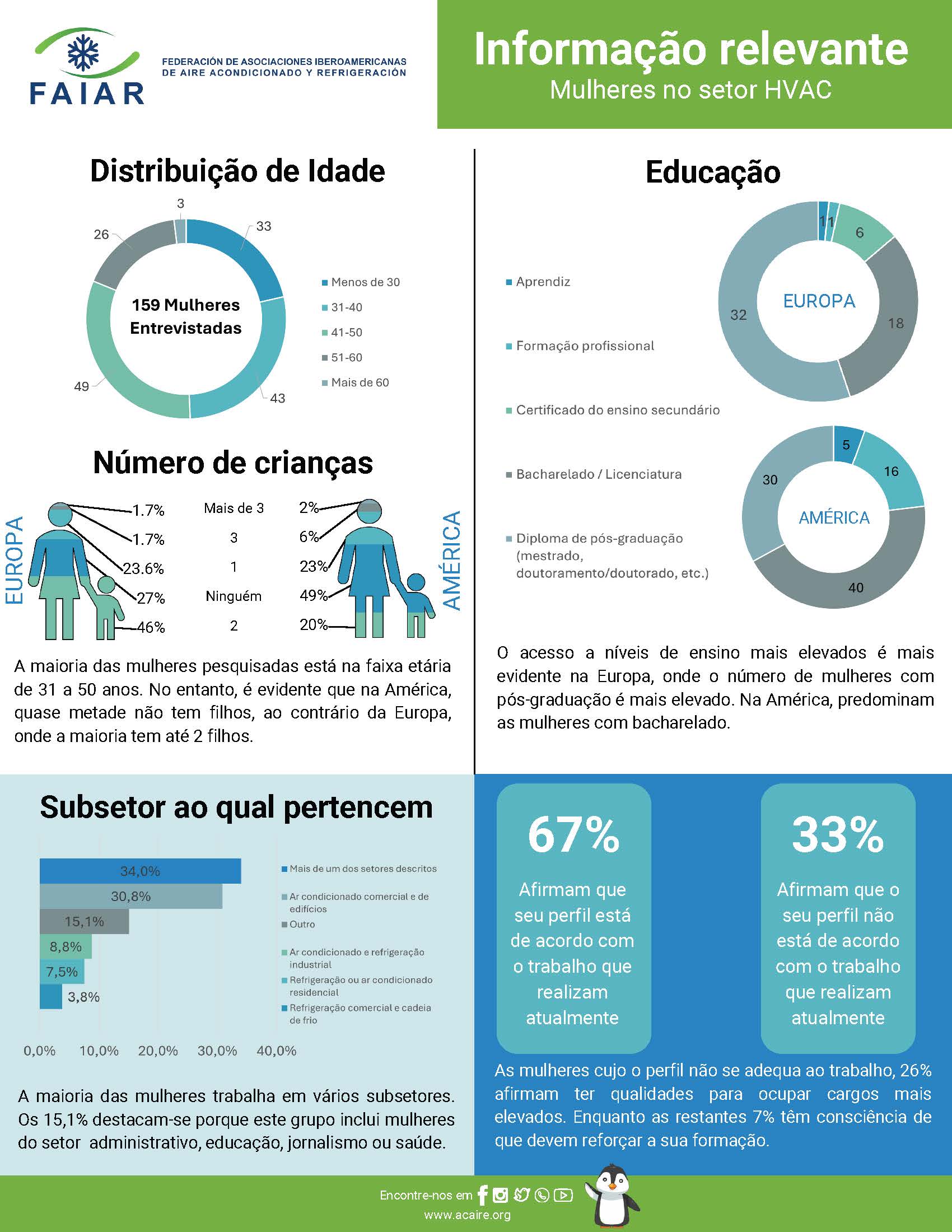
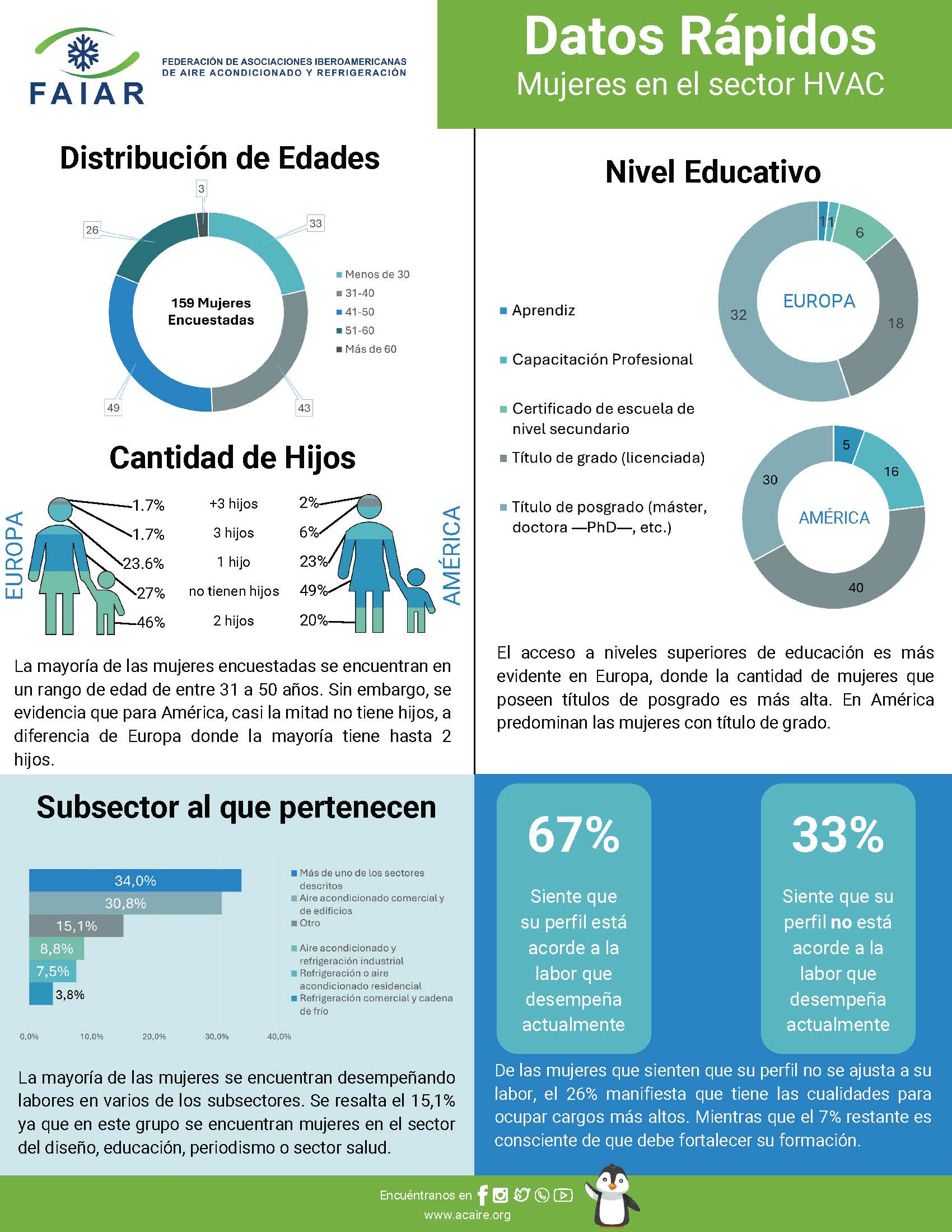
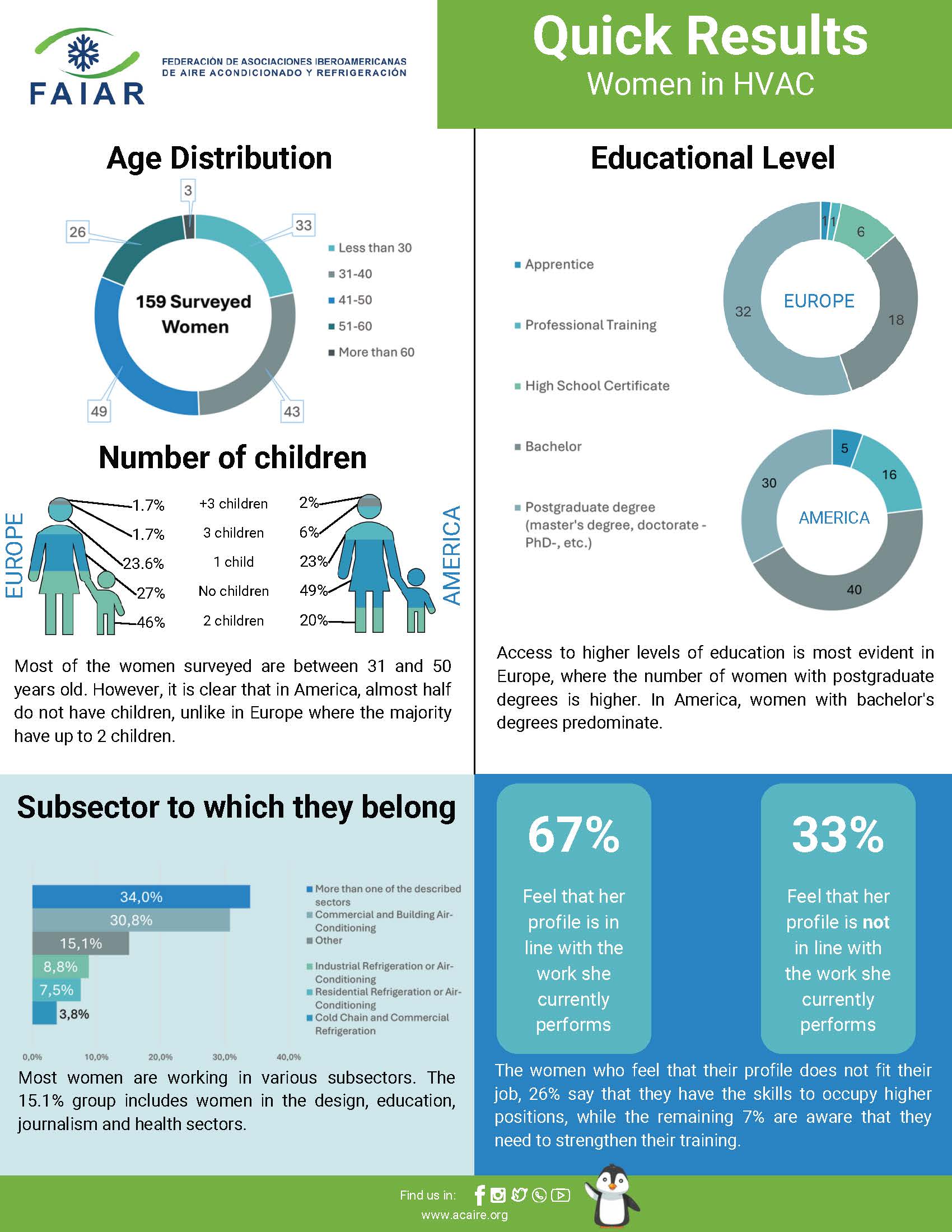
FAIAR’s survey findings, presented in Spanish, Portuguese and English. Select an image to view it in greater detail. Source: FAIAR.
The graphics summarise the backgrounds of 159 women surveyed, including their ages, education, family circumstances and areas of work. They also explore how well their current roles match their professional profiles.
Among respondents, 67% felt their professional profile matched the work they performed, while 33% felt it did not. The infographic further reports that 26% of all respondents believed they had the capabilities to hold higher positions, while 7% identified a need to strengthen their training.
These findings provide a basis for discussions about career development, access to opportunities and making better use of women’s skills across the industry.
Participation across countries
The Council’s supplied account also includes registration information for a virtual panel, recording 95 registrations: 53 women and 42 men, representing approximately 56% and 44% respectively.
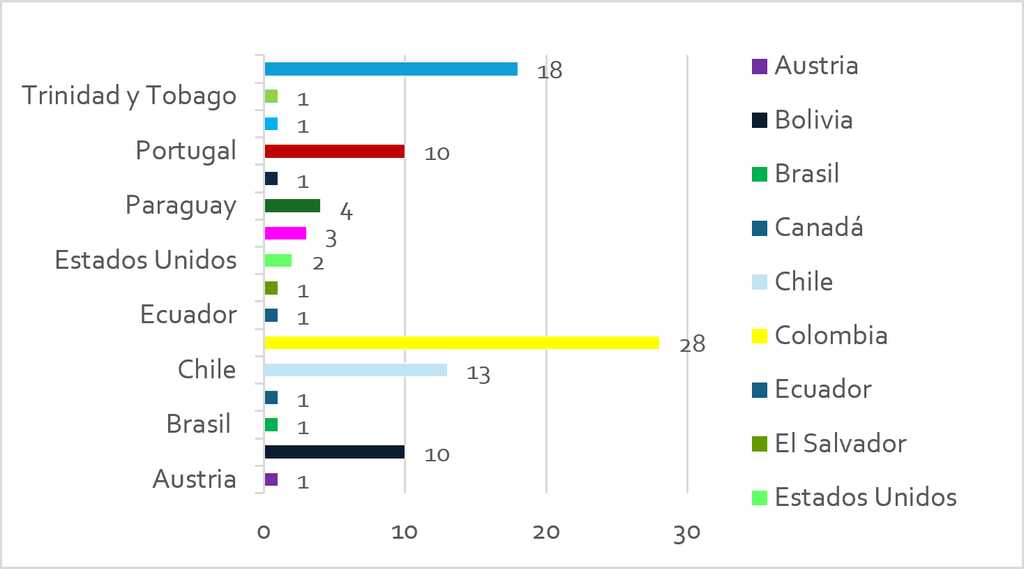
The registration figures illustrate interest in regional conversations among both women and men.
Strengthening national groups and individual women
The Council’s regional role can complement the work of national women’s organisations by connecting them and supporting the exchange of experience.
The Comitê de Mulheres da ABRAVA in Brazil and Mujeres AEFYT in Spain offer examples of national groups developing programmes suited to their own markets. Elsewhere within the FAIAR community, there may be emerging networks, informal groups or women interested in starting similar initiatives.
Colombia offers another approach. Its Red de Mujeres del Sector de Refrigeración y Acondicionamiento de Aire is an initiative led by the Ministry of Environment and Sustainable Development’s National Ozone Unit, with support from UNDP. The network brings together women from different occupations, regions and backgrounds within refrigeration and air conditioning.
Through exchanges of experience, access to institutional opportunities and technical training, it seeks to strengthen women’s skills, professional connections, participation and leadership in the sector’s technological and environmental transition. ACAIRE supports this work.
Sharing these approaches means that new groups do not have to begin from scratch. They can draw on the experience of others, discover useful practices and explore opportunities for cooperation.
The Council also offers a platform for recognising women whose contributions may have received little attention: technicians, engineers, researchers, teachers, entrepreneurs, sales and design professionals, association volunteers and business leaders throughout the Ibero-American HVACR community.
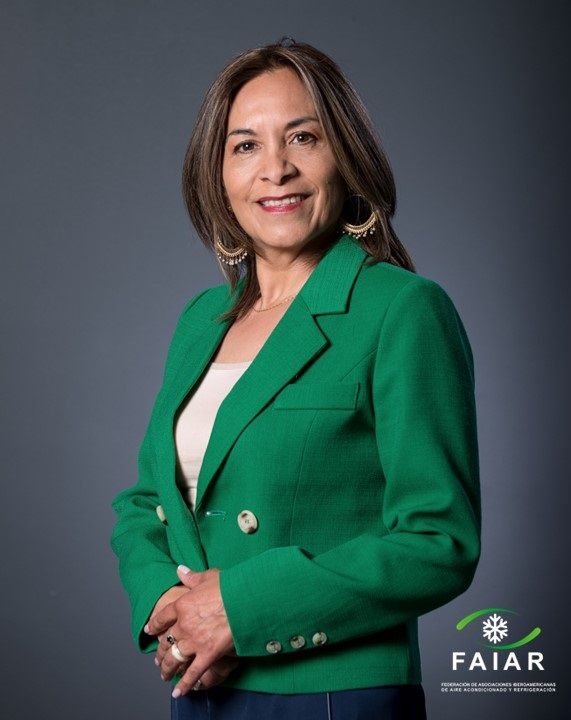
“These networks allow us to share experiences, create opportunities for development and make women’s leadership more visible.”
— María Angélica Figueroa, Vice-President of the Consejo de Mujeres de FAIAR. Translated from her interview with Revista Expofrío.
From visibility to influence
Greater visibility is an important beginning. The longer-term ambition is for women to participate in the spaces where the sector’s direction is decided.
That includes technical congresses, standards development, education, governing bodies and decisions about the future of refrigeration and air conditioning.
The transition to refrigerants with lower emissions, growing demand for cooling, energy efficiency, indoor environmental quality, food preservation and the need for a larger skilled workforce all require a broad range of talent and experience.
The Council seeks to strengthen recognition of women as engineers, technicians, leaders and decision-makers contributing to these challenges and helping guide the sector’s development.
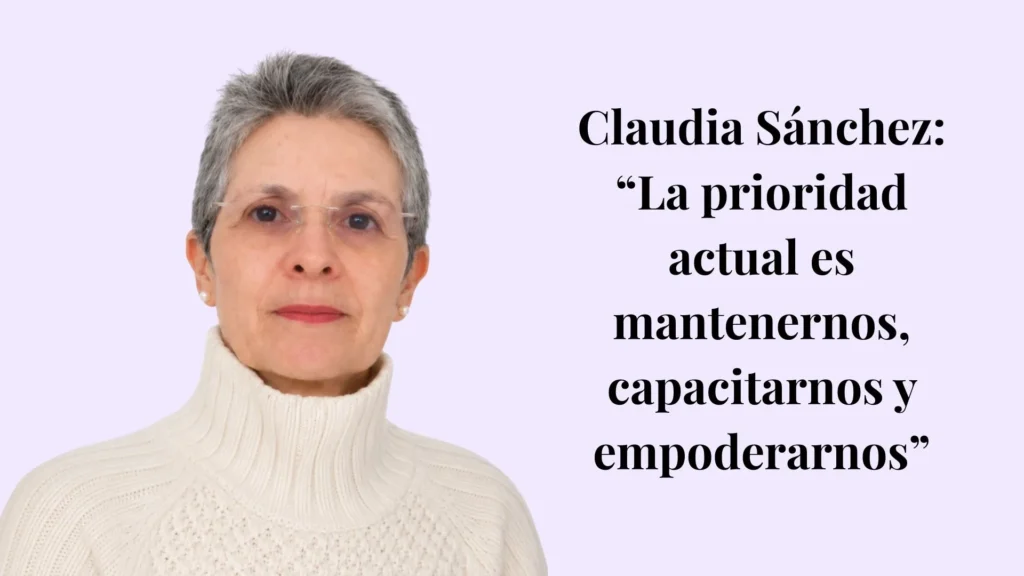
Speaking to Revista Expofrío about women’s progress in HVACR, Claudia Sánchez, Executive Director of ACAIRE, highlighted the importance of sustaining that progress through continued professional development.
“The priority now is to sustain our progress, develop our skills and empower ourselves.”
— Claudia Sánchez, Executive Director of ACAIRE. Translated from her interview with Revista Expofrío.
A regional voice within a global community
The Council also provides a collective international presence for Ibero-American women. As described in the Council’s submission, INWIC—the International Network of Women in Cooling—recognises it as a regional group supporting visibility, leadership and capacity development.
International connections allow knowledge to travel in both directions. Women from Ibero-America can learn through a worldwide community while contributing experience rooted in their own countries, languages and professional environments.
This connection between local experience and wider cooperation is closely aligned with the purpose of Global HVACR Women Week. National voices can retain their identity while gaining strength through regional and international relationships.
Building for the future
The Council’s stated objectives include promoting professional development and capabilities across HVACR, encouraging diversity, and strengthening women’s participation, visibility and leadership throughout Ibero-America.
It also seeks to develop a clear strategy that will sustain this work, make the sector more diverse and attractive to new generations, and encourage training that prepares professionals for the industry’s challenges.
Its future development will be shaped by the women and associations involved. The regional platform offers scope to widen representation, identify and connect existing national networks, establish regular exchanges, support future leaders and encourage women’s participation in CIAR and other technical programmes.
The Consejo de Mujeres de FAIAR is still relatively young, but the idea behind it is powerful. Across the Federation’s 13 countries, women already have knowledge, experience and ambition that the sector needs.
Helping them find one another—and ensuring that the industry sees and hears their contributions—can strengthen their individual opportunities and build a connected regional voice.
Find out more and connect
Learn more about the Council and its members on the Consejo de Mujeres de FAIAR webpage.